
The Value of Healthy Self-Reflection
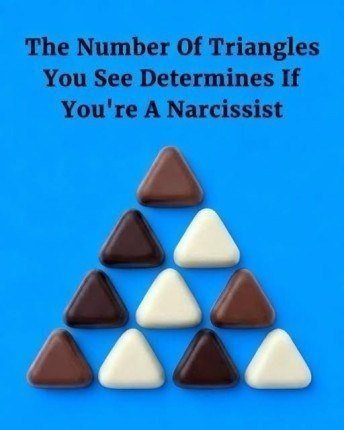
Instead of asking how many triangles you see, consider more meaningful questions:
Do I listen actively when others speak?
Can I admit when I’m wrong?
Do I respect boundaries?
Am I comfortable celebrating others’ successes?
These reflections offer real insight.
Narcissism is not about how your brain processes shapes. It is about patterns of interpersonal behavior and emotional regulation.
Entertainment vs. Education
There’s nothing wrong with enjoying a puzzle. Counting triangles can be a fun brain teaser. Optical illusions are fascinating demonstrations of how perception works.
The issue arises when entertainment is framed as psychological diagnosis.
When posts blur the line between science and speculation, misinformation spreads.
Critical thinking becomes essential.
Ask:
Who created this test?
Is it backed by research?
Are the claims specific or vague?
Does it oversimplify complex traits?
If the answers raise doubt, treat it as a game — not a verdict.
The Complexity of Human Personality
Human beings are layered. We can be confident and insecure. Empathetic and self-focused. Generous in one context, guarded in another.
Personality is dynamic. It evolves through experience, relationships, and self-awareness.
Reducing it to a number of triangles ignores that richness.
Even clinically defined traits exist along spectrums. Few people fit extreme categories neatly.
Why the Myth Persists
The triangle-narcissism myth persists because it satisfies several psychological needs:
It offers quick identity feedback.
It creates conversation.
It feels authoritative without requiring evidence.
It allows comparison with others.
And most importantly, it’s easy.
Complex truths rarely go viral. Simple claims do.
A Healthier Perspective
Instead of worrying about how many triangles you see, view such challenges as cognitive exercises.
They test:
Visual attention
Pattern recognition
Focus
They do not test empathy, humility, or emotional maturity.
If you’re concerned about narcissistic tendencies — in yourself or someone else — consider credible sources. Licensed therapists, validated psychological inventories, and long-term behavioral patterns provide meaningful insight.
Final Thoughts
The number of triangles you see does not determine whether you are a narcissist.
It does not define your empathy. It does not measure your character. It does not diagnose a personality disorder.
What it does reveal is how easily we are drawn to simple explanations in a complicated world.
Optical illusions are fascinating. Psychology is complex. Social media blends the two in ways that are engaging but often misleading.
So the next time you encounter a viral personality test based on shapes, colors, or first impressions, enjoy it for what it is: a puzzle.
But remember that real self-understanding comes not from counting triangles — but from examining patterns of thought, behavior, and connection over time.
And that kind of insight cannot be captured in a single glance.
