
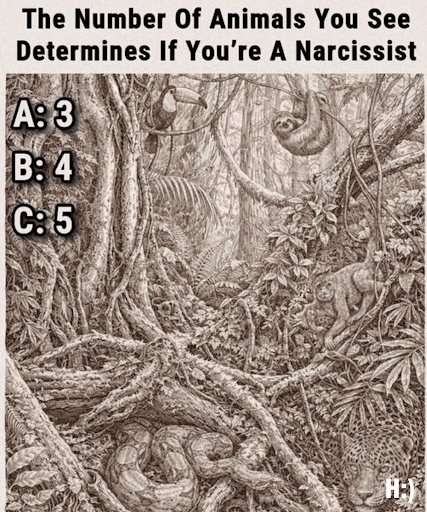
While a single image cannot measure such traits, it can spark reflection about how we perceive the world. Optical illusions like this jungle scene engage the brain’s pattern-recognition systems, challenging observers to notice details, focus attention, and reconcile what they expect to see with what is actually present. The illusion becomes a mirror for cognitive processing rather than personality assessment. How quickly someone notices the animals may reveal aspects of attention span, patience, or even cognitive style, but it does not reveal character traits such as selfishness, empathy, or narcissism.Visual illusions have long been used in psychological research to study perception and cognition. Classic examples include the Rubin vase, where viewers can see either a vase or two faces depending on how they focus, or the “hidden images” puzzles where objects or animals are camouflaged within complex scenes. These exercises reveal how context, expectation, and prior knowledge shape what we see. The jungle illusion operates on the same principles, offering multiple layers of discovery that require careful observation and mental flexibility.
Interestingly, the way people respond to optical illusions can tell us something about their thinking style, but it is subtle and context-dependent. Some viewers immediately notice all the hidden elements, demonstrating strong attention to detail and a preference for thorough scanning. Others might fixate on one area, seeing only part of the picture at first glance, which may reflect a more holistic or impressionistic approach to visual information. Neither pattern is inherently “better” or “worse”—they simply represent different cognitive styles.The online environment amplifies the appeal of these illusions by combining curiosity with self-reflection. Headlines claiming a link between an illusion and personality traits encourage engagement because people are naturally inclined to assess themselves and compare with others. In this sense, the jungle animal test functions more as an icebreaker or conversation starter than a legitimate psychological tool. Social media thrives on content that prompts clicks, reactions, and sharing, and the suggestion of insight into one’s personality—even if unverified—serves that purpose effectively.
Beyond the mechanics of perception, the jungle illusion highlights another psychological phenomenon: projection. When asked how many animals you see, individuals may unconsciously project traits or assumptions about themselves onto their interpretation of the scene. Some may believe noticing all five animals indicates intelligence or observational skill, while seeing fewer might trigger self-doubt. This reaction is less about narcissism and more about the human tendency to assign meaning to ambiguous stimuli. In other words, it reveals our desire to derive significance from perception, even when none is scientifically warranted.Educators and psychologists note that such illusions can also be valuable teaching tools. They encourage mindfulness, attention to detail, and patience, while offering an accessible entry point into discussions about cognitive processing and perception. They demonstrate how context and framing influence our understanding of what we see, highlighting the interplay between expectation and observation. In the case of the jungle illusion, viewers learn to slow down, explore the image systematically, and notice subtle cues they might otherwise overlook.
