
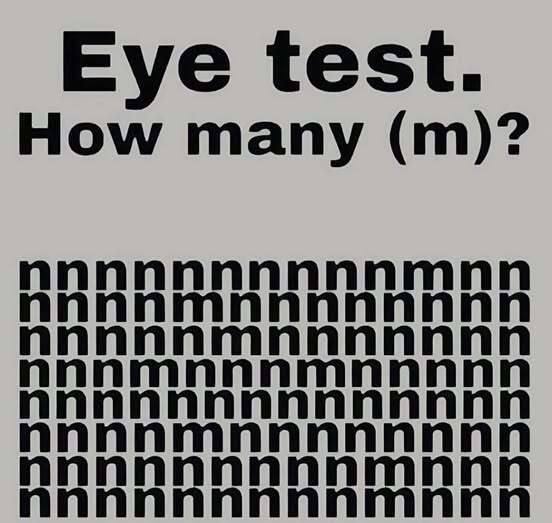
Can You Find the Hidden “M”? A Fun Visual Challenge That Tests Your Attention to Detail
At first glance, the image looks simple—just rows and rows of the lowercase letter “n.” But hidden somewhere in the grid is a single lowercase “m,” carefully placed to blend in with the surrounding letters. The challenge seems easy: find the hidden “m.” Yet many people discover that this deceptively simple task is harder than expected.
Visual puzzles like this have taken over social media feeds in recent years. They’re quick, engaging, and surprisingly revealing. What appears to be a harmless brain teaser can actually say quite a bit about how your brain processes information, identifies patterns, and handles visual distractions.
So take a deep breath, slow down your eyes, and ask yourself: can you find the hidden “m”?
Why This Puzzle Is Trickier Than It Looks
The reason this challenge works so well is because of how similar the letters “n” and “m” appear—especially when displayed in a tightly packed grid using the same font and size.
Visually, the lowercase “n” has two vertical strokes connected by a curve. The lowercase “m” has three vertical strokes connected by curves. But when dozens of letters are placed side by side, your brain begins to process them as a pattern instead of as individual characters.
Instead of reading each letter carefully, your brain switches to what psychologists call “pattern recognition mode.” It assumes consistency. When it sees rows of “n” repeatedly, it expects every letter to be the same.
That assumption is exactly what makes the hidden “m” so difficult to spot.
The Science Behind Why Your Eyes Miss It
Your visual system is incredibly efficient—but that efficiency sometimes works against you.
When you look at repeated shapes, your brain simplifies the information. It groups similar objects together to reduce cognitive effort. This process is known as visual chunking. Instead of examining each letter one by one, your brain sees a block of identical shapes.
In this case, it categorizes everything as “n” because that’s the dominant pattern.
The hidden “m” disrupts the pattern, but because it is so similar to the surrounding letters, it slips past your mental filter.
This phenomenon is related to something called inattentional blindness. When we expect to see one thing, we often fail to notice small differences—even when they’re right in front of us.
Strategies to Find the Hidden Letter
If you’re still searching, don’t worry. Most people need more time than they initially expect. Here are some practical techniques that may help:
1. Slow Down Your Eyes
Instead of scanning quickly, examine each letter deliberately. Move across each row methodically rather than jumping around.
2. Focus on Vertical Strokes
Since the key difference between “n” and “m” is the number of vertical lines, look carefully at the number of humps or strokes in each character.
3. Change Your Viewing Angle
Sometimes tilting your head slightly or adjusting the distance between you and the image can make the difference stand out more clearly.
4. Cover Sections
Use your finger or a piece of paper to block part of the image and focus on smaller sections at a time. Breaking the grid into chunks prevents visual overload.
5. Reverse the Pattern
Instead of looking for the “m,” look for letters that have an extra curve or stroke compared to the others.
Often, once you spot it, you’ll wonder how you ever missed it.
Why We Love These Challenges
